
This years marks the bicentennial of Chamblee First United Methodist Church. The church began as Prospect Methodist in 1826 and the first meetings were held outdoors or at the Prosperity Presbyterian Church just down the road.
The first Prospect Methodist building was a split-log house where the Shallow Ford crossing met Peachtree Road. The next church was built in 1847. The frame building was weather-boarded with rough boards, had simple windows and no ceiling. There was no stove or fireplace for heating.” (“History of Prospect Methodist Episcopal Church” by S. T. McElroy)
The old Prospect Church that still stands today, although greatly altered and home to local businesses, was built in 1885. Behind this church was Prospect Methodist Cemetery.
As the church grew, a new location was selected along Chamblee Dunwoody Road and the groundbreaking took place in 1965. The church recently held a weekend of events to celebrate the 200 year anniversary. On Saturday, October 24, tours were given of the historic Prospect Methodist Church Cemetery. I was glad to participate in a tour.
Many early settlers and notable Chamblee residents through the years have been laid to rest at Prospect Cemetery.
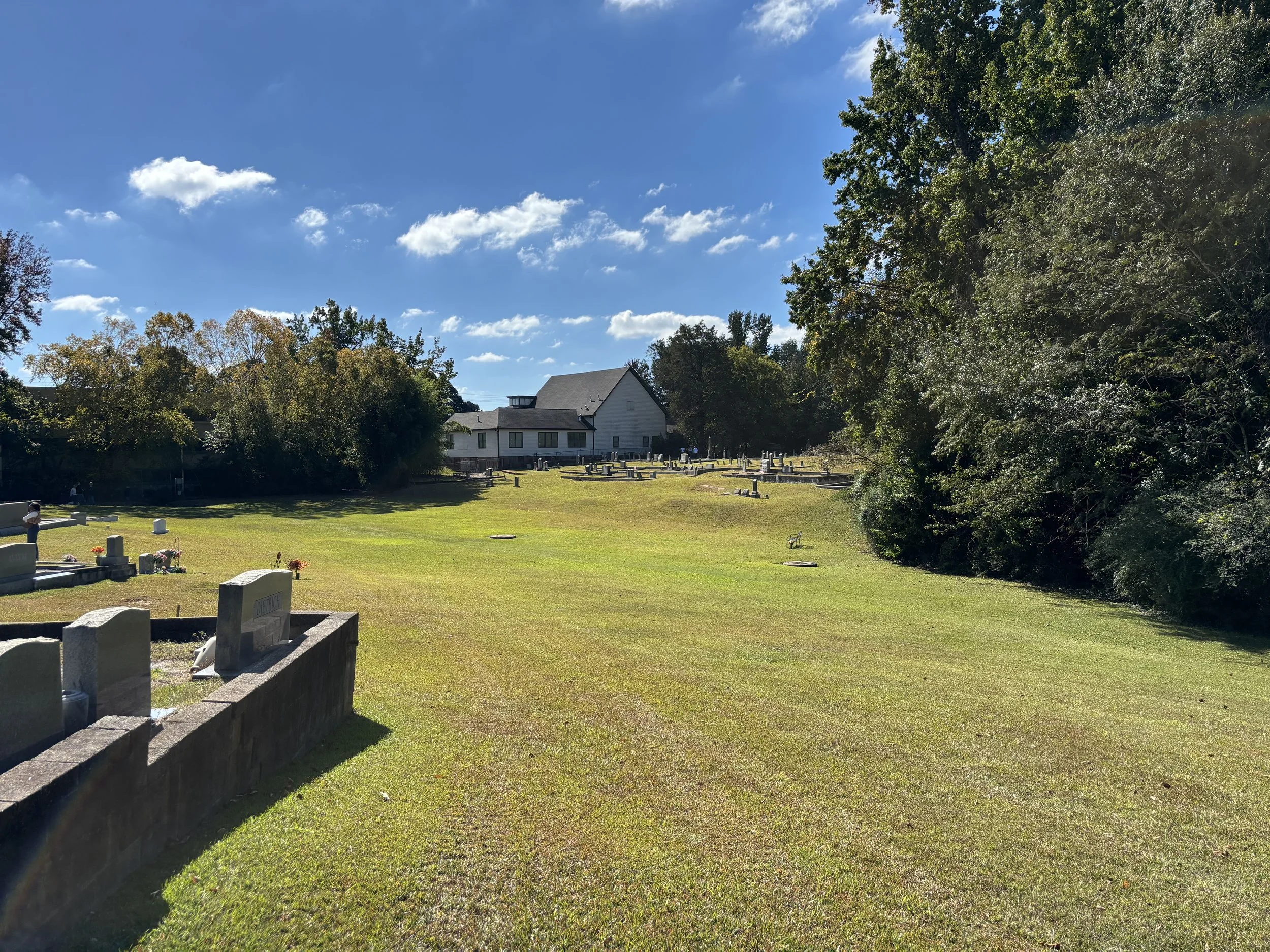
Looking across Prospect Methodist Cemetery towards the old church building from 1885. Radar imaging has shown there are 200 unidentified gravesites in this open field.
The names of some of these individuals can still be seen around Chamblee. Dr. C. C. Hart (1843-1899) is buried at Prospect. Doctor and mill owner, Harts Mill Road is named for him. There are several Tilly family members buried at Prospect, including Stephen (1782-1862), Ebenezer (1813-1865) and John W. F. (1823-1892). Stephen and his wife Rebecca came to the area in 1829, just three years after Prospect Church began.
Reavis Eugene (Gene) Lively (1937-2006), long-time Mayor of Doraville, is laid to rest here.
Estelle Gaines PIerce (1897-1984) was postmaster of Chamblee from 1833 to 1961. The Pierce family is associated with various businesses, including a gas station, store, and dairy.
William R. Wallace and his wife Nancy are buried here with five of their children nearby. Each child died within a short time of birth, not unusual at the time. Their daughter Ida Carroll lived to be 100.
Franklin Garrett visited Prospect Methodist Cemetery around 1930 to 1931 when he compiled a necrology of cemeteries in DeKalb and Fulton County. His research was limited by a focus on the burial of white males.
As with other cemeteries, he made note of people buried there without markers. He gathered this information by talking with family or neighbors during his visits. Garrett recorded Samuel House and John House without inscribed markers, while George W. House and T. J. House did have markers. The Samuel House home still stands as part of Peachtree Golf Club.
A story passed down as part of the early church history is that of the first burial. A family was passing through when their young daughter became seriously ill. The people of the church and Chamblee tried to help the family, but the child died and was the first person buried behind the church.
There are too many grave sites and stories to tell them all, but you can learn more by visiting Prospect Methodist Cemetery or by purchasing the church’s new history book, “Chamblee First United Methodist Church, 200 years, Deeply Rooted, Ever Growing.” The book is available to buy on their website.