
Historic Black community in Doraville, Carver Hills
When plans for a General Motors assembly plant were underway in the early 1940s, a community of Black families, their school and a church were displaced. Homeowners were bought out and offered land for new homes in another nearby Doraville location. General Motors bought 150 acres for the new development. Each undeveloped lot cost $2,000. The lots were one acre or slightly under one acre.
The new neighborhood was called Carver Hills, named for George Washington Carver, famous Black scientist and inventor. It was located where Peachtree Industrial Boulevard and I-285 meet. The houses were primarily built between 1945 and 1950.
DeKalb History Center recently offered a Lunch and Learn presentation of Carver Hills history with Sigrid Harris and Edgar “Chip” Jones. Harris has worked with the community of Doraville to highlight Carver Hills, which many people did not know about.
Jones’ was born in Lynwood Park and became interested in African American history. He has researched local Black history for many years. His great-grandfather, who was born an enslaved person, bought land along the Chamblee and Doraville border in 1888. Jones grandfather built a home in Carver Hills. A skilled carpenter and blacksmith, he was one of the people displaced by General Motors. The full DeKalb History Center presentation is available on YouTube.
A November 27, 1949, Atlanta Journal writeup describes a neighborhood of 50 homes. Water, lights, and paved streets were included, but property owners had to find their own builder. Many people were skilled in construction and worked to build their own homes. Both a Baptist and Methodist Church were part of the new neighborhood.
In the 1960s, the homeowners were encroached upon again, this time by the construction of I-285. The highway divided the neighborhood into two sections.
In the mid-1980s a developer wanted to buy Carver Hills property to build a hotel. Homeowner Fannie Mae Jett fought the effort to build the 145-room hotel, which would have blocked the view from the east side of the neighborhood.
DeKalb Superior Court Judge Clarence Seeliger rejected a developer’s claim that Carver Hills was a dying neighborhood and was best suited for commercial development. Fannie Mae Jett said of the ruling, “I don’t think anything in the world could thrill my heart like knowing that the old people will be able to live out their lives here.” (Atlanta Constitution, DeKalb Extra, Oct. 17, 1985, “Old Neighborhood in Doraville Refuses to Die”)
Then, in 1987 a new I-285 entrance ramp cut off another section of the neighborhood. (Photographic Permanent Archival Record, Carver Hills Historic District, copy held by the DeKalb History Center)
The Mt. Carmel African Methodist Episcopal Church still stands on Carver Drive where a few remaining Carver Hills homes are located. Some of these homes have recently been sold to developers. First established in 1879, Mt. Carmel AME is the oldest African American congregation in Georgia. The church is still active with many families returning to the neighborhood to attend the church.
New homes and townhomes have been built on the former Carver Hills location north of I-285.
In 2023, a historical marker was placed to recognize Carver Hills and the Mt. Carmel AME Church. The marker text begins, “Carver Hills, established in 1947. In the 1940s, when General Motors purchased land to build a new plant, it displaced a school, church and a number of homes belonging to members of Doraville’s African American community.”
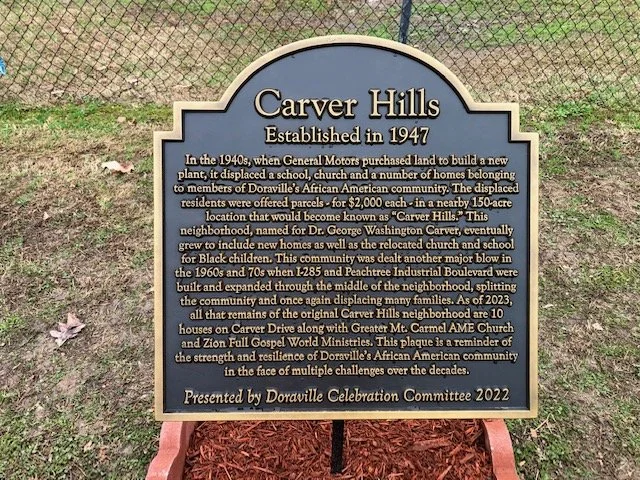
Carver Hills marker, from the DeKalb History Center
Additional land purchased for Black families displaced by General Motors includes the Parsons Village Subdivision, platted in 1953, and the Happy Valley subdivision, platted in 1954. The name Parsons comes from the previous owners of the land. Carver Hills was the only subdivision where only Black individuals could purchase land.
Former Carver Hills residents Patricia Jett Hood and Sarah Rainey Wallace were among the former and current residents who gathered for the 2023 marker dedication to honor historic Carver Hills of Doraville. Hood attended Doraville School and Lynwood Park High School. Sarah Rainey Wallace attended Lynwood Park Elementary and High School. These were segregated DeKalb County schools for Black students. Schools in DeKalb County were integrated in 1968. (DeKalb History Center Archives, oral history recordings of Patricia Jett Hood and Sarah Rainey Wallace)
Sarah Rainey Wallace’s parents and grandparents talked about their move when the General Motors Plant was built. People in the community planned to work at the General Motors Assembly plant. Wallace recalled that the former location of Mt. Carmel AME Church was in the middle of the once large community. That location today would be in the middle of I-285.
In a 1999 oral history of Fannie Mae Jett, she recalled that her grandfather Bartow Langford owned property that later became part of General Motors. The Greater Mount Carmel Church was built on her ancestor George Washington Gholston’s property. (DeKalb History Center Archives, Fannie Mae Jett)
The historical marker text continues with the history and a description of Carver Hills today, “…all that remains of the original Carver Hills neighborhood are 10 houses on Carver Drive along with Mt. Carmel AME Church and Zion Full Gospel Ministries. This plaque is a reminder of the strength and resilience of Doraville’s African American community in the face of multiple challenges over the decades. Presented by Doraville Celebration Committee 2022.”
The question of how much did black families receive when displaced by General Motors was asked, but that information was not available. If and when it does become available, this blog post will be updated.