
Early, mid and late 20th century Christmas trees
I’ve been thinking about the evolution of the Christmas tree in 1900s America and in Georgia, not the older history of how the Christmas tree first began as a tradition, but the different types of trees and where they were found in the 20th century.
In researching local history in north DeKalb County and parts of north Fulton over the last two decades, there is a similar Christmas tree story among families who lived in these areas in the early 20th century. They went out in the woods and cut one down. I don’t think that is a surprise to anyone. A tree was cut down and placed in the local church and because old churches had wood floors, the tree was sometimes nailed to the floor.
What about those that lived in the city, did they take a drive out to the country if they wanted a live tree? I don’t know the answer, but if you know more on this part of the story please email me at pasttensega@gmail.com.
In the 1930’s there was a movement in Atlanta for “living Christmas trees,” supported by women’s clubs and children’s groups, such as the Camp Fire Girls.
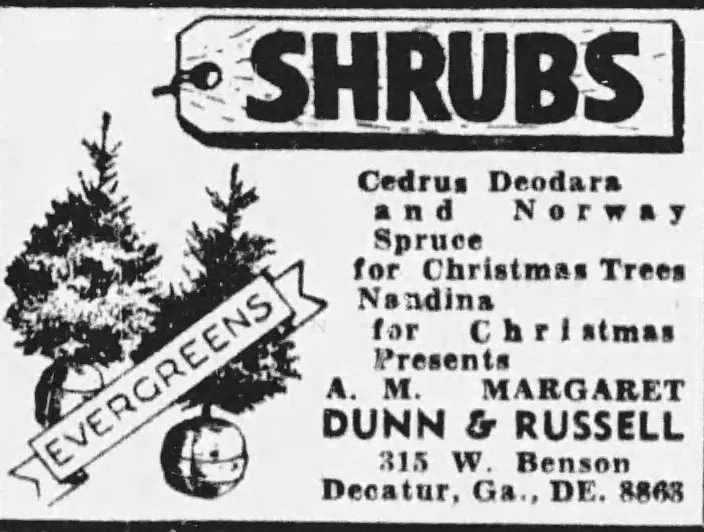
An ad for Christmas trees or shrubs and nandina plants for sale appears in the December 1939 Atlanta Journal from the property of A. M. Dunn and Margaret Russell, 315 W. Benson in Decatur. There were other family nursery businesses around the outskirts of Atlanta, but they may not have advertised in Atlanta newspapers.
Sarah Archer, in her book “Midcentury Christmas: Holiday Fads, Fancies, and Fun from 1945 to 1970,” tells how changes in the U.S. following World War II affected Christmas traditions. Soldiers returning from WWII benefited from the GI bill, which gave them funding to start a business, attend college or get a mortgage. President Roosevelt signed the bill on June 22, 1944. Although the bill should have helped all soldiers, Black veterans were often denied the ability to benefit from the GI Bill due to racism.
New home construction surged following the war. In 1944, 114,000 new homes were built, but by 1950 1.7 million homes were built, according to Archer.
The Christmas tree is tied in with the use of aluminum during WWII, “…aluminum itself was so strongly correlated culturally and visually with a certain swath of postwar America; its utility and affordability made it the new wonder material of the 1950s suburbs, but this very association made it seem uncool once the 1960s counterculture was in full psychedelic swing.”
Of course, the fact that it became “uncool” didn’t matter to everyone, as those of us who had a grandparent with a white or aluminum tree well know. The people who lived through the Great Depression would not purchase another tree when the old one was still perfectly fine. I may sound sarcastic, but I greatly admire their frugality and try to channel it as often as possible.
Archer says the first aluminum trees were made by Modern Coatings in Chicago. The motorized color wheel, placed at the bottom of the aluminum tree was created because electric lights were not safe to use on the metal branches. The trees were often advertised as made with Alcoa Aluminum, even though Alcoa did not produce artificial trees.
Even if you didn’t have an aluminum tree, those shiny strands of tinsel added silver glow to the tree. According to Archer, 20th century tinsel was made from aluminum, but lead was included for a time until banned in 1972. Next was mylar or metallic finish polyvinyl chloride or PVC.
Finally, your family may have had Shiny Brite ornaments for your tree. My mother was very protective of the glittery Shiny Brite ornaments we had. They were packed away carefully each year, back in their original boxes. I still have a few of these and if you want to relive those days the ornaments can be found on Ebay, Etsy, and in antique shops.
Shiny Brite ornaments, made by Max Eckardt & Sons in Germany, later opened a factory and warehouse in New York City. “Relatives and employees used the German method of silvering, decorating by hand. They also used glitter to add figures such as Santa, stars, or cottages.”
Woolworth’s and Kresge’s sold Christmas decorations in the Atlanta area and the outskirts of the city.
Electric string lights were another innovation of the 20th century, produced by General Electric and NOMA, a group of fifteen smaller lighting manufacturers throughout the U.S.
When I grew up in the suburbs of Dekalb County we bought our live tree from the Optimist Club. Others have told me they purchased their family tree from the Lions Club, who set up in Chamblee Plaza.
Hastings Garden Shopping Centers were selling Christmas trees in 1964 at their locations on Marietta Street, Cheshire Bridge at Lindbergh and Cascade Road at Fairburn Road. (Atlanta Journal, Dec. 4, 1964)
Christmas tree farms began in Georgia in the 1970s and 80s. Berry Christmas Tree Farm in Covington, Georgia began in 1977. Visit their website for the history of their farm.
If you are nostalgic for a mid-century Christmas tree, white, pink or blue PVC Christmas trees are still available for purchase, as well as color-wheels and vintage ornaments. Even tinsel (or icicles) is available, but there are warnings regarding the safety of pets and children. That decoration was so messy and hard to clean up, there is no nostalgia for tinsel on my part. Give me a garland any day!